21 Definitions
(Modified on 2026-08-11)
1,670 words
In music technology, our research questions and theories use keywords like: “melody,” “tone,” “groove,” “creativity,” “sadness,” “jazz,” and “tonal.” What do these words mean? If you ask ten different music experts, you’ll get (at least) ten different answers.
In linguistics, it is well known that natural human languages tend to be highly pragmatic; using contextual assumptions to be as efficient (lazy) as possible when communicating. As a result, most words and expressions have a variety of (sometimes contradictory) meanings and connotations, which can be subtly altered by context. Conventional communication and rhetoric are full of this sort of communicative complexity, leaving the exact meaning (sometimes purposefully) vague. Scholarly and scientific writing and rhetoric, in contrast, should always aim to be clear and unambiguous.
In a previous reading, we talked about what “facts” we can assume readers will agree with or accept. A common problem in writing is to not only assume that a reader will agree with you but to assume they know the same things as you. That they think about technical concepts in the same framework as you. That they are familiar with the same literature as you. That they understand words the same way as you. That they understand and use the same jargon as you, and in the same way! In fact, it is very easy even for highly-educated experts to misunderstand each other, even when they actually agree about the fundamental concepts.
Sometimes, a different interpretation can be incredibly trivial:
- You say tomato (tuh-mei-toe), I say tomato (tuh-mah-toe).
- You say gif (gif), I say gif (jiff).
- You say SQL (sequel), I say SQL (es-cue-ell).
- You say Latex (lay-tex), I say \(La\tau\epsilon\chi\) (\(lah-techh\)).
- You say L2, I say quadratic error.
I’ve been in the room when a seasoned SQL programmer said, “what the hell is Sequel?”
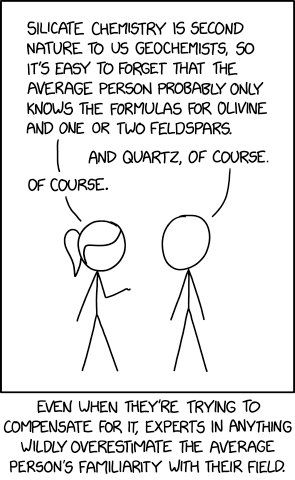
In order to communicate effectively, we need to have some agreed understanding of our definitions. If my definition of “melody” is the same, or at least similar, to your definition of “melody,” we can communicate about melody. If our understanding of the meaning of the word “melody” differs, our communication will be confused.
Unfortunately, we necessarily write and otherwise communicate our research using natural language, with all its pitfalls. Ambiguous words like “beat,” “feeling,” “style,” “tonality,” “average,” “groove,” etc. are used in music research all the time. However, even precise technical words like “algorithm” or “dependent variable” can be ambiguous, or used inconsistently. It is thus necessary to introduce or explicitly clarify our own definitions of words within the context of a paper.
When writing, you must always ask, “which words will my readers understand as I intend them?”. Never assume that your readers/audience will understand your jargon, or your acronyms. If you know your field well, there’s a good chance they will (or they’ll be too embarrassed to admit they don’t) but how much misunderstanding should we risk? If you wrongly assume a reader’s knowledge/perspective, your entire argument may be misunderstood. And readers can be annoyed. It is always better to over-define than to under-define!
Any rare or non-standard term should be italicized the first time it appears in a paper. Putting a word in italics is a signal to your reader to “Pay attention to this word. It is being used in a specific technical way.”. Immediately after the italicized word, you should explain (and if necessary, justify) your definition of the word in as much detail as needed, including citing others who have used a similar definition. All jargon and technical terms should get this treatment if 1) they are even somewhat rare/specialized or 2) you are using them in a novel or non-standard way. If you worry that your definition of a word or term is idiosyncratic, you can say something like “for the purposes of this project, we define x as …” This makes it clear that you are not suggesting that your definition is the correct definition, but only what you are using. Your definitions create a contract between you and your reader: they agree to understand this term as you define it, but only for the duration of the paper.
Scope
Part of the point of defining words in a paper, even if your audience will probably understand them, is to clarify the scope of your claims. For example, much work in the field of computational musicology has focused on “tonality” in Western Classical music. However, the word “tonality” is often used broadly to refer to pitch-organization systems in other cultures and time periods. If you are just studying Western tonal music, take a moment to explain your definition of “tonality”; this helps you clarify that your work is not meant to generalize to other musical cultures.
It’s also possible (and important) to avoid defining things that you don’t need to. For example, lots of papers refer to the term “music.” What is a good definition for “music”?—You could literally spend your career studying just that! If clarifying the definition of music isn’t important to your work, don’t bother. If you don’t take the time to define “music,” it conveys to the reader that the definition of music shouldn’t be relevant to your current work.
Audience
As always, what needs to be defined depends on your audience. If you use “linear regression” or a “Fourier transform” in almost any engineering field, you probably don’t need to explain them (or have citations for them!). However, at a biology or psychology conference, everybody will know linear regression but many won’t be familiar with the Fourier transform.
Part of your research education will be learning which terms are used freely in your (sub)field. “Statistical significance” doesn’t need to be explained in a psych paper—“Bayes factor” probably should be. “Four-four time” doesn’t need to be explained in a music theory paper—“Cross rhythm” probably should be. “Raga”; “Tonality”; “Key”; “Loss function”—any of these terms might need to be explained to the right audience.
Misuse of jargon
During the second World War, American soldiers would ask soldiers that they didn’t recognize about baseball trivia, in order to catch German spies. Later, During the USA/USSR Cold War, CIA agents would ask suspects to pronounce the name “Tucson,” hoping to catch Russian agents unfamiliar with the city in Arizona (too-sahn). Rewind three thousand years, and you’d find the soldiers of Gilead asking bystanders to pronounce the word “shibbóleth” (שִׁבֹּלֶת), knowing that outsiders from the tribe of Ephraim would pronounce the word “sibbóleth” with an “s” instead of an “sh.” The term shibboleth is now used to refer to any secret word which demonstrates your membership (or loyalty) to your group.
Technical terms and jargon should not be shibboleths. Jargon should not be used for showing off, or as a “buzzword.” Jargon should be used when it is the clearest and most precise way to explain your research. This is often the case! However, if you can explain something more clearly without jargon, you should.
This advice can be difficult to follow. For one, it might feel pedantic, boring, or insulting to explain “obvious” things to your peers. In contrast, confident use of jargon makes you sound smart, and helps you fit in to the club. Taking a minute to define a term, or to ask somebody to define or explain a term, might make you feel dumb. However, you will find that senior scholars, and peer reviewers won’t be shy to ask for clarification, and neither should you.
Acronyms
The words of an acronym should always be spelled out the first time they appear in a paper. If you are going to reuse the acronym, then introduce the acronym in parentheses immediately after the full spelled out name. Absolutely do not just use terms like LR, FT, IOI, or SDR without first spelling them out! “LR” or “FT” could be anything!
- You say FFT, I say DFT.
- You say LR, I say SR.
- You say Hertz, I say cps.
How are we supposed to know what you mean? It’s your job to communicate to your audience! Even if an acronym is used all the time in your field, it must still be spelled out when first used.
In general, acronyms should only be used for specific named things (like algorithms or theories), and for terms that you are going to use a lot in your paper. If you refer to “multi-level models” three times in your paper, don’t bother with an acronym. If you refer to the Discrete Fourier Transform twice, don’t call it DFT the second time. If you aren’t using a term multiple times in multiple paragraphs (say, more than ten times total), you probably shouldn’t be using an acronym at all.
Citation
Can we simply cite a definition? No, not exactly. You can and should use and cite other scholars’ definition(s) as a way of reinforcing the legitimacy and validity of a definition. But, this doesn’t usually mean you can get away with not explaining the cited definition, if it’s important to your argument. For example, if I write
We did a computational analysis of tonality (Huron, 2006) in EDM music.
you have no idea what I mean by “tonality.” You’d have to read Huron’s book just to find out what I mean by “tonality.” Instead, I could write:
According to Huron (2006), tonality is the emergent result of perceived tendencies associated with tones in a diatonic collection. We perform a computational analysis of tonality in EDM music.
Now I’ve given a succinct definition of “tonality,” and attributed it to Huron (2006).
Example
Here is an idealized example of some sentences introducing new terms:
In our analyses, we represent rhythms as strings of inter-onset-intervals (IOIs): the absolute time (in milliseconds) between successive note onsets, ignoring duration. Because we use IOIs as our rhythmic encoding, our analyses ignore distinctions between legato (sustained) and staccato (quickly cut-off) notes.
Note that I give a very thorough definition of inter-onset-interval, including the unit of time (milliseconds) I am going to use. However, for “legato” and “staccato” I only provide brief definitions—this implies that these terms are not as important to the research.
Mantras
Using concise and precise technical terms is a good thing, if it enhances clarity. When in doubt, it’s better to over-define and explain than to under-explain, to make totally sure your readers/reviewers understand what you are saying.
Define acronyms and jargon. Don’t assume everyone will understand the words you use the way you understand them—explain what you mean by different terms. Don’t be afraid to repeat yourself.