2 Questions and Answers
(Modified on 2026-08-13)
2,224 words
Research is a search for knowledge. But what knowledge are we searching for? What is the question we are asking?
A research question doesn’t just identify a topic, or an unknown. A research question is an attempt to identify and articulate what we want to know. “What we want to know” is the answer to our question. What sorts of answers do we want? The form of the question frames the form of the answer.
If you ask a question like
Do men listen to music at higher volumes than women?,
there are two possible answers: Yes or no. In contrast, a question like
Which genre is most popular among teenagers in Georgia?,
has many more possible answers: Hip hop, Country, EDM, etc. This second question asks for a more complex and informative answer.
But now, consider another question:
Why do some people like to listen to music at higher volumes?
What will the answer to this question look like? Whatever the answer is, it must be much more complex. It might be something like “Testosterone binds to epinephrine receptors, so people with higher testosterone levels have less intense adrenal responses when exposed to sensory stressors like loud noises, allowing them to experience the benefits of louder listening levels without the negative physiological response.”
So, what makes this third question different than the first two? The first two ask for descriptions; The third asks for an explanation—a theory.
A theory is an answer to a why or how question—an explanation of a phenomenon, usually causal. In general, an explanation is more valuable than “merely” a description (Gale 1979, 64). English question words like “do” or “which” generally ask for descriptions. In contrast, words like “how” and “why” demand explanations.
Description
Of course, answering descriptive questions is valuable. Descriptive research is often an invaluable first step when exploring a new topic. You need some “basic” empirical evidence to work with before you can start generating or testing theories. In fact, it can be a huge waste of time to ask why prematurely: if your research question is “why are oboes more popular than guitars?,” your research is not going to be very fruitful.
In some areas, description may be all you really need. This is especially true in engineering. You may need to know what the optimal wire gauge is to build an instrument, not why. However, even where a description may be sufficient, an explanation is usually more valuable. To illustrate, consider these three yes/no questions:
Does heavy metal contain more violent lyrics than other genres?
Do heavy metal fans engage in more violence than non-metal fans?
Does listening to heavy metal make you more violent?
Imagine that we could wave a magical wand to answer these three questions, and we found that the answer was “yes” in all three cases. What would we gain from this new knowledge? Well, it could be useful to, for example, guide public policy for music venues or primary schools. But what if a policy-maker comes along with follow-up question:
Does watching violent TV make you more violent?
Do our previous answers help us with this new question? No. Because description doesn’t really allow us to generalize. This is the problem of induction! However, we start over from scratch with our magic question-answering wand, but this time we pose a different question:
Why might listening to violent music correlate with violent behavior?
The answer to this question would be much more rich and complex than our previous questions. If we could explain why violent music might correlate with violent behavior, we’d be in a much better position to generalize to other questions, like about TV.
Fortunately, most descriptive answers (“do” or “which” questions) are connected to broader theories/questions. For example, consider these three questions again:
Does heavy metal contain more violent lyrics than other genres?
Does listening to heavy metal make you more violent?
Do heavy metal fans engage in more violence than non-metal fans?
These three questions actually suggest an implicit causal theory: “Heavy metal fans engage in more violent behavior because they listen to music which has more violent lyrics.” I see this all the time with student research questions: descriptive questions which dance around an underlying theory. You should always try to broaden your “do/which” questions and identify what the overarching, or underlying, theories you are interested in are.
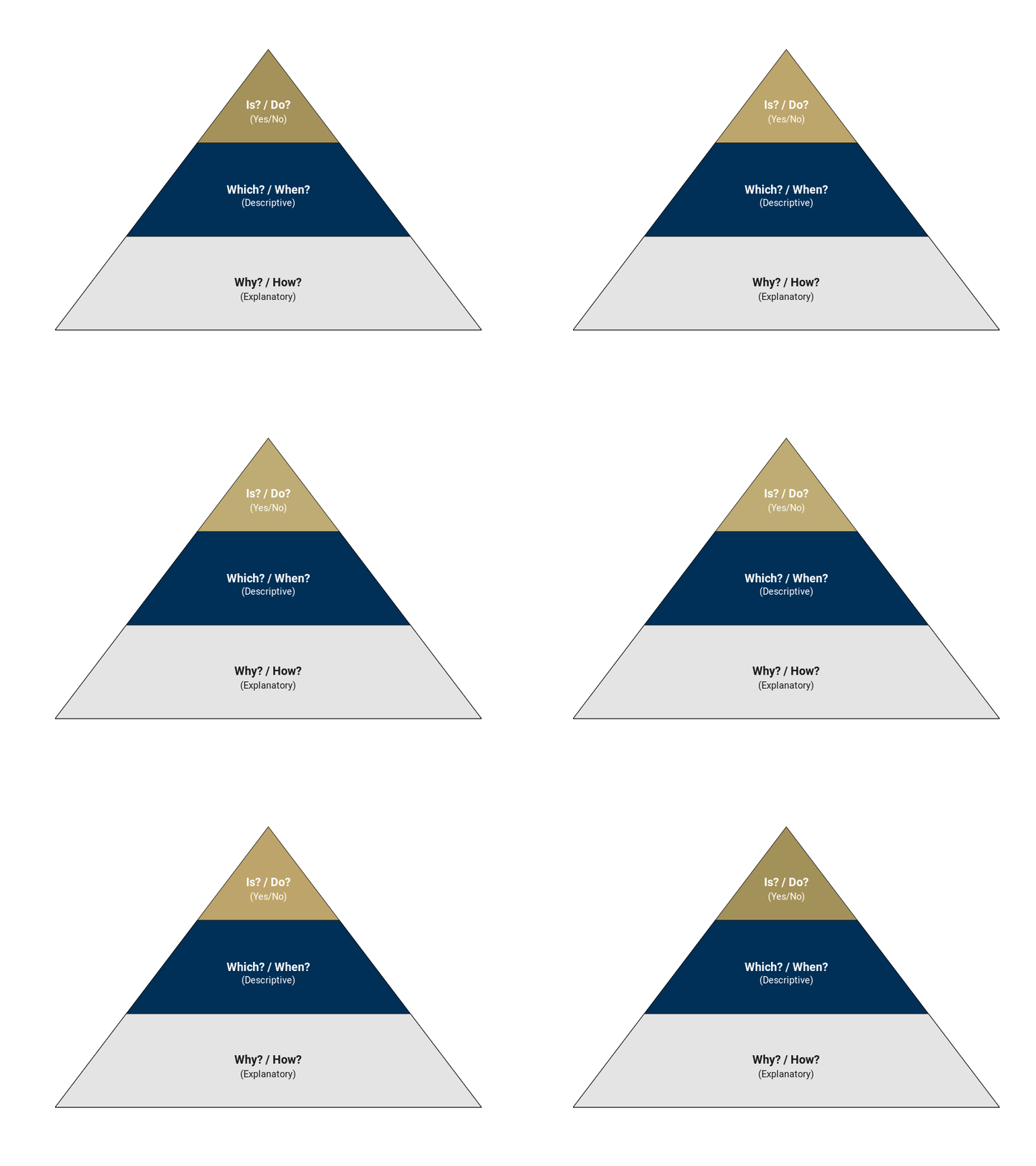
Hierarchy of Questions
- Explanatory questions
- Why is x true?
- How does x happen?
- Descriptive questions
- Which x is true?
- When does x happen?
- Yes/no questions
- Is x true?
- Does x do this?
Good Questions
Whether descriptive or explanatory in nature, there are a few qualities of good research questions. A good question is
- well informed;
- makes valid assumptions;
- has appropriate scope;
- is not too specific, but also not too general;
- is feasible to answer.
Well Informed
Ideally, researchers have thorough understandings of existing research in their field before asking questions. A poorly-informed question may have already been answered. Poorly-informed questions are often naive. You might ask “how are chord progressions in traditional Indian music different than in Western music?” That sounds like a reasonable question except there are no chord progressions in traditional Indian music!
I expect students to ask (somewhat) poorly informed questions. Hopefully, at the end of your graduate studies you’ll be much better-informed. Truthfully, even seasoned researchers can have trouble keeping up with published research and end up asking poorly-informed questions. This is especially true for multi-disciplinary topics like music science/technology, where we must keep up with advances in multiple fields of research.
Valid Assumptions
Sometimes questions simply make invalid (or at least uncertain) assumptions. Many students ask things like “Why do people do x?” and I reply “do people actually do x (frequently/sometimes/ever)?!” Our questions are often motivated by our personal experience, and it makes sense that things we have personally observed in your lives will motivate us to ask questions. But we should always ask: is this thing I’ve observed really common? Sometimes our personal experience/observation is not typical—we may have skewed perspective on things, especially things that we care about.
This is why descriptive research is often the first step. You might want to ask “why do educated people prefer more complex music?” But before we can even begin to answer this question, we have to first ask: “Do educated people actually prefer more complex music?”. “Do musical styles actually vary in their overall complexity?” “How do we define or measure music’s complexity?” Once these questions are answered, we can proceed to the more interesting question which we started with.
Appropriate Scope
Very often, research questions are either too specific or too general. Something too specific will not be interesting or useful to the broader research community. Something too general will either not be practical to answer or of no use when answered!
Too Specific
It’s very easy to get overly focused on specific questions that are meaningful to you specifically. This is especially dangerous when combined with poor-information.
In our lab, we like to think in terms of “big knobs” and “small knobs.” If you were to explain to someone how to drive a car, would you start by showing them the blinkers, windshield wipers, or how to operate the radio? No. You start with the brakes, gas, and steering wheel. Those are the big knobs. A lot of research out there is hung up on “little knobs”—often when we don’t even know what the big knobs are yet! When exploring a new topic/domain, focus your attention on the big knobs (important factors) first, before getting into the nitty gritty details.
Sometimes an overly-specific topic just doesn’t make sense as a distinct domain of inquiry. For example, you’ll very often see research that is focused on a specific genre: I’ve seen papers on “microtiming progressions in punk rock” and “chord progressions in 1990s country.” The problem is that, the researchers actually don’t have any good reason to believe that there is anything special about punk-rock microtiming or 90s-country chord progressions—they just like these genres, so they study them!
I did my dissertation work on rap music. Early on, I spent a lot of time trying to analyze the use of syncopation in rapped rhythms. However, I came to realize that rhythm in rap delivery is very closely related to rhythm in other popular musics (rock, R&B, EDM, pop, reggae, etc.). It didn’t make sense to study syncopation in rap in isolation; it made more sense to study syncopation in American popular music.
Studying “syncopation in rap” would have made sense if there was already a lot of research regarding syncopation in popular music. If we already had a solid understanding of syncopation in general, it would make perfect sense to “zero in” on something more specific, like syncopation in rap. In this case, that general understanding wasn’t already in place. Alternatively, studying syncopation might have made sense if I had some strong theoretical or empirical reason to believe that syncopation in rap was special, or significantly different than other genres. I didn’t. This contrasts with the example of rhyme: the use of rhyme in rap is definitely very distinctive and special, so it would make sense to study it as a distinct topic.
Similar problems often come up when music researchers are interested in the instrument they play. Maybe you want to study how the timbre and articulation of the trumpet express emotions. We should probably first study how timbre and articulation expresses emotions in music in general!
Lots of social and perceptual inquiries can also be problematic.
- People use music to regulate their mood, right? People also use TV, books, exercise, and food to regulate their emotions. Does it make sense to study music as a tool for mood regulation, independent of these other things?
- People use music to express their identity and to form social bonds with their “in group.” People also use clothes, accessories, sports, arts, and pretty much everything else we do to express our identity. Does it make sense to study music as a tool for social identity, independent of these other factors?
Sometimes a “reduced domain of inquiry” is simply the only practical approach. Studying the expressive power of one instrument is a lot easier than studying all instruments, and it might make sense practically. Studying one rhythm in one genre is easier than studying all genres, and it might make sense practically. However, when we’re thinking big picture about the questions that motivate our research we want to aim for an appropriate level of generalization. If we are forced (by our limited resources) to be more narrow, then so be it.
Too General
Another problem with many research questions, is being too general.
How does music express emotion?
How does the brain process music?
How can deep learning enhance music production?
You’re going to need life-times of research to hope to answer these! Giant, general, ambitious questions like these are good because they motivate us and help us stay focused on the big picture that really matters—feel free to include these on your “long list.” However, if your questions are too general, you’ll never answer them.
One of the great things about explanatory questions is that their answers often lead to new (and better questions)…which lead to more questions…and so on. The whole world is interconnected. However, we can’t start by trying to explain the whole world at once.
When we try to pick out anything by itself, we find it hitched to everything else in the universe.
— John Muir
Interest
Another important criterion to consider is simply whether the research question is interesting. Will your readers be interested in the answer? Will the community see this as a valuable contribution? Most importantly, do you want to answer the question?; If you aren’t motivated, you’ll rarely finish a project.
Unfortunately, there is a flip side to this: The scientific community, like any human community, suffers from a bias towards exciting, flashy, sexy ideas. It is up to us to consciously make an effort to counteract this tendency. Sometimes answering mundane questions can be an important precursor to later research, maybe in the short term; maybe in the long term. Often questions seem “mundane” because they seem to have obvious answers. Reviewers might say “that’s obvious, why bother”, “duh,” or “my grandma could have told you that.” David Huron calls these “grandma questions.” However, sometimes grandma questions reveal surprising answers, which are extremely valuable exactly because they are unexpected. And we won’t know unless we ask!
In your own work, you need to make the argument that your work is valuable. You might have to fight an uphill battle to convince people that apparently “mundane” questions are worth answering. In some cases you might need to push back a little with reviewers and editors, if your work is being rejected just because it’s not flashy. Conversely, when reviewing other people’s work, don’t reject work just because it seems boring (to you).
Originality
Another factor that affects how your work could be received is its originality. Has this question already been answered? Dr. Weinberg always asks what “white space” your research is filling. Reviewers are likely to have a similar question. However, this is another area where community practice may actually diverge from the ideal. It is well known that replication of previous studies is extremely important, yet far too rare. Original ideas are far more interesting, and there is a definite bias against replication. The best research often incorporates some replication of related work alongside new work.
Mantras
We’ll review these ideas through some more course mantras:
“Why” is the question that leads to the most interesting and useful answers. (“How” is good too.) The answer to a why question is a theory.
Of course, before asking “why,” make sure the concepts you are asking about are (at least plausibly) valid. If you are making assumptions, do background research to validate those assumptions.
When exploring a new topic, the first thing to do is to figure out what the major, important aspects of the topic are. Don’t go off into the weeds if you haven’t first surveyed the forest. Beware that your specific experience/interests and passions, which are personal to you, can blind you to the big picture.
Everything is interconnected…especially when it involves human thoughts and behaviors. You can’t explain it all. Don’t try to. Bite off chunks that you can chew.