6 Prediction
(Modified on 2026-08-11)
947 words
The Rhetoric Of Prophecy
In 1494, Christopher Columbus embarked on his second voyage to the Americas. On May 5th of that year he landed on the island now known as Jamaica. He told the local native Jamaicans that in two days time, the moon would rise up and swallow the sun—plunging the midday into darkness. Two days later, the midday sun did darken, and the native Jamaicans were awestruck—deeply impressed and terrified by Columbus’ prophetic abilities.
Throughout history, the most powerful form of rhetoric has been prophecy. Why are prophecies so enthralling? Why would the natives of Jamaica be so impressed by Columbus’ prediction? Well, there are only two ways to account for a prophecy coming true:
- The prophet was lucky.
- The prophet knows something.
Luck
Could Columbus have simply got lucky?
Suppose I predicted that tomorrow it will rain in Seattle. I doubt anyone would be impressed if it did, in fact, rain! Why? Because it wouldn’t take much luck for my prediction to come true—rain in Seattle is quite common! To be rhetorically effective, prophecies should seem improbable—something that no one else would or could predict. A claim like “the moon will rise up and swallow the sun” is a pretty improbable claim!
Note that we do sometimes make lucky predictions—and it can be very hard not to be impressed! In fact, people very often mistake luck for prophetic abilities, like gamblers becoming convinced they are “on a streak” and continuing to gamble. As we will learn, the key role of statistics in scientific methodology is to (attempt to) account for the role of luck!
Knowledge
If luck is unlikely, then it appears the prophet knows something. We may be convinced that they have magic abilities or can communicate with the gods (in most of the world’s religions, prophetic texts are among the most revered documents). Or, we may understand that the prophet is in possession of a useful theory of the universe that makes it possible to produce such predictions with a high likelihood of success.
Science provides compelling stories because it relies on the rhetorical power of prophecy. Its persuasive power lies in improbable predictions. Christopher Columbus could have told the Jamaicans a story about how, in the past, he had seen “the moon swallow the sun.” They might have thought this story was interesting and entertaining. But instead, Columbus told them a story about the future—a story that (improbably) came to pass. A future-tense story is much more impressive than a past-tense story.
Prediction is the ultimate rhetorical tool to justify knowledge—to convincingly argue that our models are in fact, close to the Truth. Even better, prediction is useful. If we can successfully model the universe, then we can use that knowledge to do useful things, like avoiding predators, growing food, finding mates, etc. It is prediction that is key. Science is a community of scholars who hold each other to a methodological commitment to making and testing predictions.
Falsification
Consider something else about Columbus’ eclipse prediction: it is very specific and unambiguous. When the Jamaican natives observed the eclipse, there was no question that what they were seeing was what Columbus predicted. Conversely, if Columbus had been wrong, and there had been no eclipse, it would have been very obvious that he was wrong. Contrast this with the sorts of predictions that appear in many generic horoscopes and fortune cookies: “I foresee great tribulations in the road ahead,” “You will find happiness in unexpected places,” or “your effort will finally pay off.” These predictions are vague. Many possible events could be interpreted as fulfilling these predictions. We can almost always find a way of interpreting them as being right—this also means that is very difficult for them to be proven wrong. These sorts of vague predictions are not so different than predictions of rain in Seattle—inevitably, correct. Unfortunately, the rhetoric of prophecy is so strong that many people find vague “horoscope-style” predictions compelling.
The strongest rhetoric comes from predictions that are specific and falsifiable. The exact prediction is clear, and the criteria for a wrong prediction is equally clear. An interesting prophecy can be tested. The genuine possibility of failure is crucial to the rhetoric of prophecy. Good research makes every effort to be falsifiable.
Hypotheses
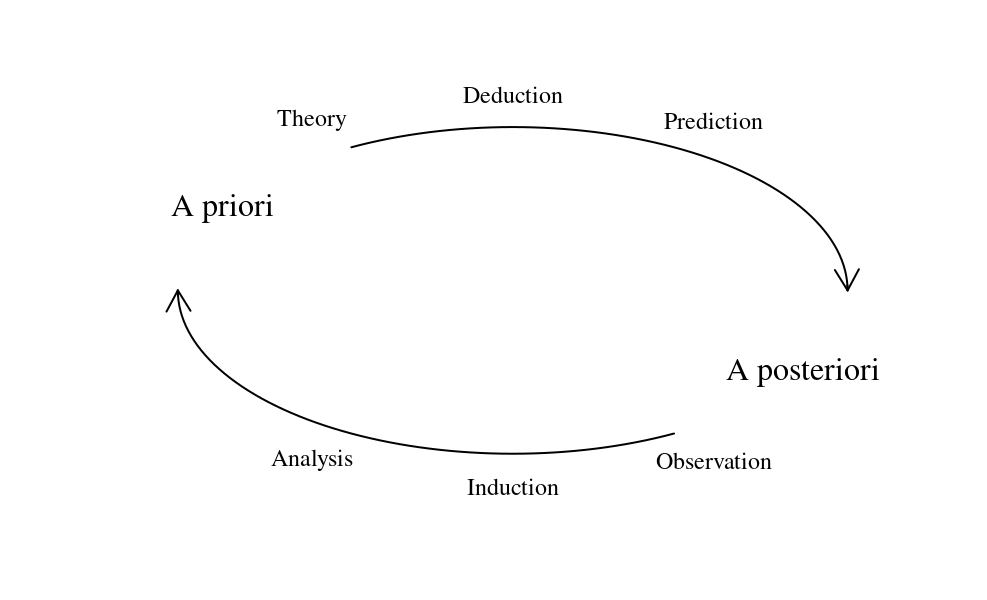
As we’ve learned, science synthesizes rationalism (theory) and empiricism (data). The primary means of synthesizing the two is prediction. From our theoretical knowledge, we deduce specific, concrete predictions about future observations. These theoretical predictions are a priori, coming from reasoning before observation. We then make those observations, and evaluate whether the observations match the predictions of the theory. If the data doesn’t match our theory/prediction, our theory must be revised or discarded.
A hypothesis is the name we give the link between theory and prediction. A theoretical explanation that leads to a specific falsifiable prediction—\(Theory \implies Prediction\).
Example: Music listening loudness preferences are determined by testosterone levels; therefore, we predict that if we measure a sample of participant’s testosterone levels and ask them to set music levels to their preferred level, the testosterone measurements will correlate with preferred listening level.
Failure
When your hypothesis is falsified, it may feel like your project has failed. This is not the case. You successfully falsified a hypothesis; that is a success.
There is well-known, and universally decried, bias in the community towards “successful” hypotheses. Researchers may be hesitant to publish research which fails to support their hypothesis. Reviewers can be biased against these papers too. This is a bad thing. All published prophecies are correct, so where is the falsification?
Fortunately, the community is increasingly aware of this problem. Some journals are adopting standards where you submit a paper before gathering data, so it can’t be rejected based on a “failure.”
Mantras
The rhetoric of science is the rhetoric of prophecy. Prophecies are compelling because, if they are accurate, they can be useful, and if they are not, they cannot hide. Making concrete, testable (falsifiable) predictions is the bedrock of science.
In contrast, exploratory research is most valuable when mixed with hypothesis-driven research. Don’t fall into the (easy) rut of doing only exploratory work.
Falsifying a priori predictions makes for compelling rhetoric—but the hypothesis test is just one example of a broader idea that should inform all research. To claim your conclusion is true, it must be possible for it to be false. So when you start a project, ask: what would it look like for my ideas, data, or claims to be wrong? If they can’t be wrong, you’re probably reasoning in a circle. Put your neck out—take a risk.
Mantra: A null is not a nothing DontFuss
The strongest research claims can be made when we attempt to falsify our hypotheses. This means that, if we are doing science right, we will sometimes get negative results. Negative results are always disappointing, but they are not a professional or personal failure—if you falsified your theory, you are doing research right. It is essential that we view “negative results” as real, valuable results, and aim to publish and disseminate them. Burying failed predictions in the file drawer distorts the whole literature.
The special rhetorical power—and epistemological credibility—of science rests, more than anything else on the idea that we try to disprove our own theories, not prove them! Of course, we don’t really want to disprove our theories, but to make our claims scientifically compelling we must design our experiments to disprove our theories. Being totally objective is never possible, so in practice we design in such a way to slightly “tip the scales” against our theories. This, in part, helps counteract our own natural confirmation biases.
NULL