23 Reductionism
(Modified on 2026-08-11)
2,008 words
Reductionism is a fundamental part of scientific inquiry. However, there are at least two ways of interpreting the term “reductionism.”
Philosophical Reductionism
The more contentious notion of reductionism is the school of thought known as philosophical reductionism: the “it’s nothing but” mode of explanation. According to this view, complex phenomena are “merely” convoluted manifestations of a small number of simpler, fundamental causes or interactions. In this form of reductionism, the researcher aims to make statements of the form “X is nothing but Y.” The game of pool is nothing but friction and inertia; Weather is just thermodynamics; Love is nothing but hormones and synapses; Dissonance is nothing but beating in the cochlea; etc. Culture is just sociology, sociology is just psychology, psychology is just biology, biology is just chemistry, and chemistry is just physics.
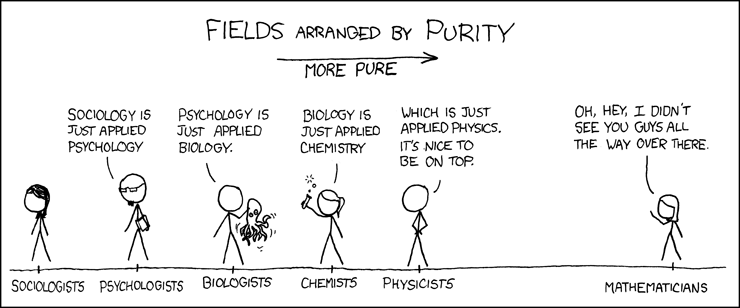
Philosophical reductionism, especially when applied to humans and human culture, has always been controversial. Humanities scholars of many stripes have derided the reductionist project. Much of the objection originates in the unsavory aesthetic repercussions of “nothing but” reductionism. It is argued that such reductionistic accounts “explain” only in the sense of making flat. The world as an enchanting place is transformed into a prosaic, colorless, and seemingly senseless enterprise. Among humanities scholars, musicians and musicologists have been among the most vocal critics of “nothing but” reductionism. Many music scholars explicitly embrace complexity and scorn simplicity. Composer John Cage cautioned strongly against such “logical minimizations.”
Philosophical reductionism can be contrasted with what is sometimes called holism. A “holist” expects to explain phenomena as being greater than the sum of their parts (a process dubbed synergism by Buckminster Fuller). Frequently, synergism leads to “emergent properties,” where complex phenomena cannot be predicted even when a thorough understanding exists of the underlying constituent phenomena.
Of course, holism has problems as well. From an extreme holist perspective, every thing and every event is a unique combination of constituent phenomena. If everything is unique (or special), then there can be no generalization. My experience of love is totally different and unrelated to your experience of love, or anyone else’s.
Ultimately, philosophical reductionism is self-evidently true: everything is “just” energy and matter and interactions of the four fundamental forces. The question is, when does it help to reduce things this much? What level of reduction is appropriate for helping us understand something? Saying that love just boils down to interactions of electrons and protons is true, but it’s also totally useless. It doesn’t help us understand what love is. Conversely, failing to acknowledge that love is a common human experience, obviously rooted in culture, psychology, and biology, is just as foolish.
Methodological Reductionism
There is another way of interpreting “reductionism”—as a potentially useful strategy for discovery rather than a belief about how the world is. This alternative interpretation might be described as the “divide and conquer” method of inquiry—where the researcher examines one factor with the hope that manipulating this single factor will help shed some light on a complex phenomena by isolating constituent relationships.
A Story About Farming
Throughout the nineteenth century, the British government maintained a number of experimental farms scattered throughout various parts of the country. The goal was to better understand how to increase crop yields and provide appropriate research-based advice to farmers. Which crops grow better in which regions. Which varieties grow better at different altitudes, with different amounts of sunlight, rainfall, and fertilizers. What combination of soil-type, moisture, etc. are most productive?
Throughout the century, employees kept detailed records for each field they planted. They measured the amount of sunlight, the average temperature, and the amount of rainfall. They recorded when the crop was planted, when they applied fertilizer, when it was harvested, and the total amount harvested. After nearly a century of collecting data, they had ledger after ledger of information. But they didn’t know how to analyse the data. One year, they would plant variety A of wheat and harvest 2,900 bushels. The following year they planted variety B of wheat and produced a slightly lower harvest. However, the second year received more rainfall, but had less sunlight and a lower average temperature. Was variety A better than variety B? Or would variety A also have done worse if the amount of sunlight was less and the temperature lower?
In order to try to make sense of this data, the British government hired statistician Ronald Fisher in 1919. Fisher took a long look at the records and concluded that no conclusion was possible in most cases. Each year, too many things had varied at the same time so it was impossible to figure out what factor or combination of factors was responsible for higher or lower harvests. Fisher changed the way in which the experimental plots were used. Instead of planting a single crop in each field, the government farmers planted two crops. The first row would be variety A, the second row would be variety B…and so on, alternating across the field. In this way, both variety A and variety B would receive the same rainfall, the same amount of sunlight, the same soil, etc. Fisher understood that if you want to understand the effects of many factors, you need to manipulate only one factor at a time.
Nearly a century of data collection was useless because too many variables changed at the same time. Within a few years after Fisher was hired, the experimental farms produced highly useful data—establishing, for example, that variety A was better than variety B, except in areas that receive high levels of rainfall, etc.
Fisher demonstrated that if you want to understand a complex system, you must reduce the complex problem to one simple question at a time. Manipulate only one variable at a time (by controlling or randomizing covariates) and observe what happens; After observing the effect of one variable, move on to another variable (like the amount of fertilizer). As you gain more knowledge, you can increase the number of simultaneously manipulated variables, building up a sophisticated model of the phenomenon in question. But if you want to make progress, you must start by manipulating just one variable at a time.
When we try to pick out anything by itself, we find it hitched to everything else in the universe.
— John Muir
The whole world is interconnected. In explaining the world, we must ultimately account for all of the interconnections. However, we can’t start by trying to explain the whole world at once. We simply don’t have enough knowledge.
When something is too complex to make sense of, the first step is often to “assume” a simplified model, and study that first. To reduce a complex problem to a simpler problem; Or to reduce a set of complex, interrelated problems to a set of simpler, independent problems. Simplifying a problem does not mean we believe the problem is simple. In fact, we simplify problems because we believe them to be complex. Researchers, or entire fields of research, might focus on studying one part of a bigger question/area. Simplifying a problem is not a statement about how the world is, it is merely a strategy for discovery.
None of this assumes that our reductive assumptions are “true.” In fact, we know they aren’t true. We know that we are making unwarranted assumptions, and we must remain skeptical of our conclusions. But you’ve got to start somewhere. In scientific enterprises, philosopher Alfred North Whitehead offered the following apt advice: “Seek simplicity and distrust it.”
Methodological reductionism attempts to form good theory by progressively refining simplistic theories. As the anthropologist Clifford Geertz (1973, 33) wrote:
Scientific advancement commonly consists in a progressive complication of what once seemed a beautifully simple set of notions but now seems an unbearably simplistic one.
Do not be afraid to start with a theory that is unreasonably simplistic. In fact, we must begin with unreasonably simplistic theories if we have any hope of understanding a phenomenon in its full richness.
Reductive Theory
When simplifying a problem, there are many possible simplifications. How do you know which simplification to begin with?
Before you begin any study, you will know that many factors influence a phenomenon. Do not start by trying to deal with all factors simultaneously. This will lead you to large volumes of uninterpretable results. Instead, start with what you think is the most important factor first. Then move on to what you think might be the next most important factor.
Consider, for example, the phenomenon of musical taste. Why does a person prefer the music he/she likes? We might suppose that age, sex, personality, nationality and socio-economic background all play a role in determining taste. If you think that the most important factor influencing musical taste is teenage peer influence, then begin there.
Similarly, consider the question: In orchestration, why do composers selected the instruments they do? Again, we might identify lots of factors that could influence a composer’s choice of instrumental combinations. These might include the ability of instruments to “blend” with each other; the distinctiveness or novelty of different instrumental colors; or the suitability of some instruments to be more noticeable than others. However, if you think that the most important factor influencing a composer’s choice of instruments is loudness, then start with loudness.
There is another reason why we should avoid beginning with complex theories. Complex theories are commonly difficult to test. Because of the proliferation of variables in a complex theory, and because the relationships between the variables are usually not fixed, most complex theories can be used to account for any set of observations. To anticipate some technical terms we’ll learn later, complex theories have more “degrees of freedom” with which to “overfit” the data.
Imagine two nineteenth-century British agronomists talking about crop varieties A and B. The first agronomist advocates a complex theory that variety A is superior to variety B, but only when there is high sunshine, low rainfall, and low soil acidity. So “why,” asks the second agronomist, “did variety B in field #3 in 1893 do better than variety A in field #18 in 1887?” “Ah, that’s because field #18 has a higher elevation and too much fertilizer was applied.” The second agronomist then recalls another case: “If variety A is sensitive to too much fertilizer, how do you explain the high yield in field #18 in 1883 when the same amount of fertilizer was applied?” “Ah, that’s because the crop was planted earlier in the season and the fertilizer was administered twice rather than all-at-once.”
Nearly any set of observations can be explained using a suitably complex theory. As a theory becomes more complex, it allows more “wiggle room.” The first agronomist can always adapt his complex theory to account for new data. Despite the appearance of usefulness, such theories are actually useless. Only by narrowing the theory, adding restrictive conditions, and limiting interactions, do we allow the world to tell us that we’re wrong.
Simple theories are dangerous because people might erroneously believe them to be true. Complex theories are dangerous because it is hard to shake people’s erroneous belief in them. Complex theories are best built through piece-wise additions to a simpler theory. Each additional component to the theory is tested along the way.
Reductive Measurement
One of the fundamental necessities of empiricism is that we can consistently measure things. In order to systematically compare observation to theory, we need to be able to classify, and when possible quantify, observations. We need future, unobserved data which can conflict with (or falsify) our predictions.
In psychology work, measurement is often highly reductive, for both conceptual/theoretical and practical reasons. Our operational definitions are often extremely simplistic and reductive. For example, “Indicate happiness on a five-point scale.” However, there is often no obviously better alternative. What’s more, sometimes there are simply no practical alternatives. You can’t ask participants to write ten-page essays on how each stimuli makes them feel. This doesn’t mean we totally accept or believe in our measurements. We don’t claim that our measures capture the “essential” essence of the construct we are measuring. On the contrary, we always remain skeptical of the construct validity of our definitions.
Mantras
Everything is interconnected…especially when it involves human thoughts and behaviors. You can’t explain it all. Don’t try to. Bite off chunks that you can chew.
The most common criticism of scientific practice is that it is overly reductive: “reducing” the rich tapestry of reality to a handful of simple variables in an equation. This is a reasonable concern! However, as scientists, we should remind ourselves (and our critics) that we don’t believe our reductions are “True”: We reduce complex problems to simpler problems because it is a useful approach. This means that, when we make claims based on our “reduced” ideas, we have to be humble about how broad and meaningful we can generalize.
When we define terms, we are not claiming that our definitions are complete or correct. We always remember that our operational definitions—our measurements—are imperfect. We never measure the essential truth of something, only a rough model of it. Your definitions create a limited contract between you and your reader: you agree to understand this term this way, but only for the duration of the paper.