1 Epistemology
(Modified on 2026-08-26)
2,255 words
Through seeking we may learn and know things better.
But as for certain truth, no man has known it
Nor will he know it; neither of the gods,
Nor yet of all the things of which I speak.
And if by chance he were to utter the final truth, he would himself not know it:
For all is but a woven web of conjectures.— Xenophanes
The goal of research is to create and disseminate new knowledge. What is knowledge? How do we define good vs bad knowledge? How do we create knowledge? These are questions of epistemology, the study of knowledge.
Epistemologists identify two fundamental sources of knowledge: deduction and induction. Deductive reasoning is the basis of rationality. Inductive reasoning is the basis of empiricism. Science synthesizes these sources to create a uniquely powerful form of research.
Rationality
Deductive knowledge is the product of rational thought, including reasoning and logical analysis. Deduction is introspective—the work of our mind. Deductive knowledge is also called a priori (“from the earlier”) knowledge, because it comes before, or is independent of, experience.
Deductive reasoning tends to be top down, starting from first principles and reasoning to specific cases. We begin with existing knowledge and use deductive reasoning to construct new knowledge.
Examples of deductive reasoning:
- If all people are mortal, and Socrates is a person, then Socrates is mortal.
- \((x > y) \land (y > z) \implies (x > z)\)
- Smaller objects have resonant modes at higher frequencies; Fretting a string on the sitar makes the string shorter; Therefore, fretting the string will make the frequency higher.
- The first 8 pages of a Beethoven manuscript are written using a dark blue ink. The remaining 11 pages in the manuscript use a more purple-colored ink. An accompaniment figuration for a phrase near the beginning of the work is written using the purple ink. If we assume that the purple ink was used after exhausting the dark blue ink, it follows that the accompaniment must have been added after the melody line was written.
Empiricism
Inductive, or empirical, knowledge is the product of observation—the work of our senses. Observation may occur informally, or we may create a formal plan for observation. An example of informal observation is what we call “experience”; An example of formal observation is an “experiment.” Inductive knowledge is also called a posteriori (“from the later”) knowledge—because it comes after experience. Inductive reasoning tends to be bottom up, starting from specific observations and generalizing to construct new knowledge.
Examples of inductive reasoning:
- I know that many birds are capable of flight because I see them fly.
- I’ve observed that some musicians can identify the names of isolated pitches (“perfect pitch”) and others can’t.
- I have witnessed only a couple of occasions when people dance without music: People rarely dance without music.
- I know that some music can send shivers up my spine because I have experienced this.
- I know that works for xylophone are much more likely to be in the major mode than works for marimba because I’ve examined (and counted) a large number of works for xylophone and marimba.
- I observe that every time the sitarist presses their fingers on frets closer to the bridge, the pitch increases. I know that fretting position controls the pitch.
Empiricism, the epistemological view that empirical observation can justify knowledge, is central to science. In fact, the word “empiricism” is often treated as synonymous with the word “science.” “Empirical analysis”; “Data-driven approaches”; “Big Data”; etc. However, empiricism alone is insufficient as an epistemology for science.
The Problem of Induction
David Hume (1748) first formulated the The Problem of Induction: No amount of observation can decisively establish the truth of some general statement. The classic illustration has to do with swans. In Europe, centuries of empirical observation supported the conclusion that all swans are white—Europeans knew this to be true. That is, until European explorers traveled to Australia and observed black swans! Thus, as Hume argued, induction is inherently fallible: No matter how many swans we observe, we could never know that all swans are white!
Consider another example: If I listen to two hundred rock songs and all include snare drum attacks on the “back beats” 2 and 4, can I conclude that all rock songs have back beats? No. Would any number of observations “prove” this conclusion? No! The problem is that inductive reasoning cannot generalize to cases we haven’t observed. This contrasts with deduction; Mathematicians regularly prove statements are either true or false within a deductive framework. Only by combining induction with deduction can we start to reason beyond what we have observed.
Consider again the conclusion that “all rock songs have back beats.” We cannot prove this through observation. But could we disprove it? Certainly! All we need is to find one rock song with no back beat. Just as a single black swan disproves that all swans are white, a single new observation can alter (or destroy) our empirical knowledge! So induction can disprove (falsify).
Conventional Knowledge
The pairing of deduction and induction gives us a neat epistemological framework for understanding research. However, most human knowledge is generated in much more mundane, messy ways, relying on conventional sources of knowledge, such as intuition, “common sense,” our senses, and especially authority.
- The chicken salad in my refrigerator is not old, but it seems to smell a little odd. I decide to throw it out rather than eat it.
- A woman is shopping for a car. She feels a vague sense of unease about the salesman and so decides to go to another dealership.
- A man about to cross the street jumps back when he hears the sound of a car horn. The reaction is so fast, he is not even aware of having thought about anything.
- A piano teacher suspects that the reason why her student is not progressing faster is because he is not practicing enough. She decides to phone his parents.
- My car mechanic tells me the screeching noise is caused by a loose timing belt—I ask her to replace it.
Conventional sources of knowledge can be problematic in various ways, and are not considered to be legitimate bases for scholarly research. However, it is not feasible to operate without them! You can’t independently observe or reason about everything from scratch. What’s more, some of our intuitions have been shaped by millions of years of evolution to save our lives. Especially in matters related to music-making, the most important knowledge we have is probably intuitive knowledge. Without intuition, music-making would be impossible.
Conventional (intuitive), deductive, and empirical forms of knowledge are all necessary for life. Each form of knowledge adds to the value of the others. That is, they are complementary forms of knowledge.
In addition, each form of knowledge also has limitations. There are times when our intuitions prove to be wrongheaded. For example, a child’s intuition may tell him not to let a nurse stick a needle into his arm—even though an inoculation will help prevent illness. Here, intuition fails us. There are many situations when rational deduction proves to be impossibly complicated or time-consuming. For example, when identifying the pros and cons of purchasing a particular house, we may find it impossible to “calculate” all of the pertinent factors. Here, rational deduction fails us. Regularly watching the local television news, an elderly person may conclude that their neighborhood is full of crime, and that she should refrain from going outside for her daily walk. Here, observation fails us.
Science
Scientific research synthesizes inductive and deductive knowledge (Gale 1979). We begin with a priori (“from the earlier”) knowledge, from which we reason (and predict). We gather empirical observations to expand and test our current knowledge, creating a posteriori (“from the later”) knowledge. Our a posteriori knowledge then becomes the basis for more reasoning/deduction, and the process repeats.
Theory and reason are needed to gather and interpret data. Data is needed to evaluate (test) and motivate the improvement of theories.
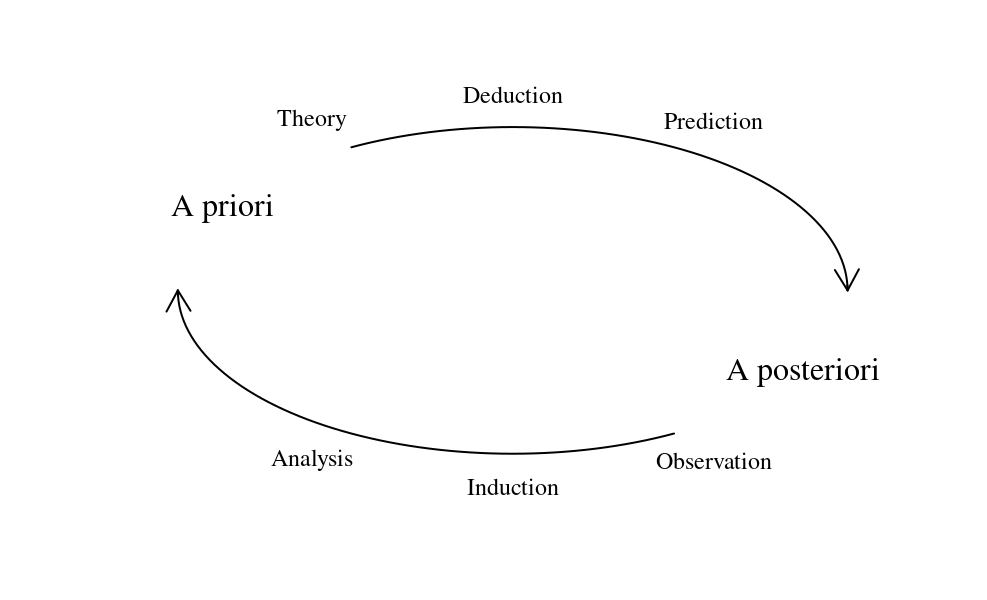
An example: We observe the sun rise every day, but we can’t from this conclude that the sun will rise tomorrow. However, from many observations we induce the existence of gravity and inertia. We deduce theories of gravity and inertia which match our observations. We can deduce then that the Earth will keep spinning for eons.
| Rationalism | Empiricism |
|---|---|
| Deduction | Induction |
| Mind | Senses |
| a priori | a posteriori |
| Theory | Data |
| Logic | Observation |
Throughout the process, whether we’d like it or not, conventional sources of knowledge also play a role: Citing existing research as a source of authority; Using our intuitions to come up with research questions, or design experiments; Fundamentally, all empiricism is reliant on our senses!
Truth
The most fundamental epistemological assumption is that there is Objective Truth. That is, that an external, objective reality exists independently of individual rational observers (like us). “Objectivity” is often seen as the uniquely powerful aspect of scientific knowledge. Science is based on objective facts and observation, in contrast to subjective opinion…right?
Unfortunately, scientists are not the only people to claim to know Objective Truth. Some point to the Quran for objective truth, or the Vedas, or the Bible. Others read objective truth in the alignment of stars, or in tea leaves, or tarot cards. Of course, all of us who aren’t ignorant sheeple know that the objective truth is the opposite of what NASA says! The world is flat! The moon landing never happened! Chem trails!
Clearly, people have many different, and often contradictory, beliefs about what is true, and what isn’t. So how do we decide what’s really “the Truth”? How can we, as researchers, make a special claim to know it? Why should we believe science over religion or conspiracy? Epistemologists relate these questions to the idea of justification: what can justify one belief about the universe over another? What is the justification of scientific knowledge?
Skepticism
The first step towards justifying knowledge, is simply acknowledging that we don’t know the Truth. That we are capable of holding false beliefs; That our knowledge is fallible and at best an approximation of the truth. That any of us can fall prey to inductive/deductive errors. That we can never be sure of the truth, even when we have it. This is why, at least since the time of the ancient Greeks, the essence of good scholarship has been skepticism. A good scientist is skeptical of everything, especially ourselves (Gale 1979, 70–72).
Error
A skeptic knows that their knowledge/beliefs are always wrong. The question is how they are wrong. Good knowledge is less wrong than bad knowledge.
In making any knowledge claim (including the claim that something is unknowable) there are two kinds of errors we can make. Methodologists call these Type I and Type II errors. It doesn’t matter whether the source of a knowledge claim is intuition, deduction, or induction.
- Type 1 error
- Believe a false proposition is true.
- A false positive.
- Type 2 error
- Believe a true proposition is false.
- A false negative.
| Thought to be true | Thought to be false | |
|---|---|---|
| Actually true | Correct inference | Type II error |
| Actually false | Type I error | Correct inference |
Since antiquity, thinkers have recognized that the human mind is predisposed to many deductive and inductive errors. David Huron has identified 63 examples here. Modern science now explains why many of these biases exist. Evolution is pragmatic and often messy: our minds have evolved to operate using rough heuristics that can be applied quickly and tend to work well on average. This includes our tendency to rely heavily on “conventional” sources of knowledge (e.g., intuition, tradition/authority). These biases and fallacies cannot be unlearned. Experts at all levels fall prey to them.
Imagine some of our ancient ancestors, sleeping at night in the African savanna. Out of the dark, they hear the sound of a twig snapping. Some might respond, “a lion is stalking us, we should flee.” Others might think, “it’s just a branch blown out of the tree by the wind.” In the long run, which thought process is likely to survive? If the pessimistic sleepers are wrong, they end up wasting a bunch of energy and don’t sleep well. If the optimistic sleepers are wrong, they could end up dead. In nature, the risks associated with a Type I error are often far less than the risks associated with a Type II error. Thus, the most significant bias we have, is a tendency towards false positives (Type 1 errors)—to “jump to conclusions.”
People who engage in research are optimists, since they must think that through their own actions it may be possible to acquire new knowledge. For this reason, active researchers are more likely to make Type I errors (i.e., claiming something to be true that is not true/useful/knowable) than Type II errors. Since all humans are biased towards Type I errors, and researchers in particular tend to be hopeful and optimistic, the principal danger in empirical research is our own eagerness to discover something. The greatest danger to the scientific skeptic is confirmation bias: our tendency to believe what we want to believe. Consequently, throughout the history of empirical research, the principal concern has been to minimize or avoid Type I errors.
As we will see later, when research involves quantitative data, it is often possible to estimate the probability of making a Type I or Type II error. Although modern science is several hundred years old, the ability to measure the probability of error is less than a century old, and is one of the most important advances in modern empirical methodology.
Mantras
We can start to piece together and summarize the epistemology of science in our first set of course mantras.
There is no magic wand or method that simply produces objective knowledge; the best we can do is find beliefs we hope are useful models of the Truth. Scientists can look and feel objective—passive grammar, jargon, lots of numbers—without being so. Worse, once we’re confident of our own objectivity, we stop questioning our beliefs, which is the opposite of good science. Own your subjectivity; don’t hide from it.
Good scientists don’t claim to prove anything. We are motivated by truth, but we don’t aspire for “proof.”
Though induction can not prove propositions, it can disprove them; Thus, we approach research from the perspective of trying to disprove our ideas. If we can’t show that we are not right, then maybe there is a hope that we are “not not right.”
There is always error in our knowledge. Our goal is to minimize these errors, not remove them.
There is no way to evaluate knowledge absolutely—we’d have to know Objective Truth to do that. What we can do is evaluate whether one model is more useful than another.
The greatest barrier to good research is confirmation bias. We want our research to “succeed,” and there are many ways that we can consciously or unconsciously help the research “succeed”—or appear to succeed. This is why the main concern in scientific methodology is the control/reduction of Type-1 errors—stopping ourselves from making false-positive claims. Our reviewers are on the lookout for ways that we might bias the design, implementation, execution, or interpretation of our research in our favor.
Admitting, owning, and quantifying how wrong we might be is what sets good science apart from other sources of knowledge. Counter-intuitively, acknowledging imperfections earns readers’ trust: if a reader spots a flaw we never mention, they assume we never saw it, and our credibility collapses. Name the problem first, then argue—with humility—that the work is still valuable.