39 Measuring Music
(Modified on 2026-08-11)
2,281 words
Music is not a fact or a thing in the world, but meaning constituted by human beings.
— Thomas Clifton (1983)
Music, often an art/entertainment, is a total social fact whose definitions vary according to era and culture.
— Jean Molino (1975)
The border between music and noise is always culturally defined—which implies that, even within a single society, this border does not always pass through the same place; in short, there is rarely a consensus…By all accounts there is no single and intercultural universal concept defining what music might be.
— Jean-Jacques Nattiez (1990)
Measuring “Music”
So you want to measure music? Well…what do you mean by “music”?
The nature of the construct “music” can, and often does, inspire passionate debate. How do you define music? Good music? Bad music? Real music? Fake music? Different cultures, and even different individuals, can (and do) favor radically different answers to these questions: different models of what “music” is.
From the perspective of anthropologists or biologists, music is a human behavior—something that we do. Ethnomusicologist Christopher Small (1998) coined the term “musicking” to encapsulate all the ways that human beings “do” music:
To music (verb)
- To take part, in any capacity, in a musical performance.
- …to play music, to perform music, to make music, to compose music, to produce music;
- …to listen to music, to enjoy music, to appreciate music, to be affected by music;
- …to talk about music, to write about music, to discuss music, to study music;
- …to dance to music, to groove to music, to (make) love to music;
- …to worship to music, to meditate to music.
Of course, musicking can be measured like any other human behavior.
Now, the only reason Small (1998) needed to invent a new verb “to music” is because, in English, “music” is definitely a noun—an object, a thing. Indeed, we have words for many musical “objects.”
music (mass noun)
- A series of sounds organized in time, or audio or visual representations of such sounds.
- …comes in units such as “works,” “pieces,” “tracks,” “songs,” and “recordings”;
- …is made up of components including “melodies,” “phrases,” “cadences,” “beats,” “notes,” and “chords”;
- …has features such as “structure,” and “form”;
- …is a “product” or “property” that can be bought or sold.
These words all suggest that music itself is “stuff” that exists independent of human behavior. Western musicians, with their long tradition of notated music, are particularly prone to viewing music this way; In fact, in the Western classical tradition, “the music” and “the score” can be synonyms. Any particular performance of a “work” is viewed as almost incidental or irrelevant to the “real” thing, which is written in the score. This score-centric view of music has been widely criticised by anthropologists, sociologists, and ethnomusicologists, especially when it has been super-imposed on non-Western cultures. Scholars in these fields have argued that the Western idea of “the music itself” is an artificial, reification of the real music: i.e., the behaviors and experiences of people musicking.
Musical Artifacts
Fortunately, the perspectives of “music as behavior” and “music as object” are not really conflicting. After all, one way we can music (verb) is by making music (noun): we make musical objects, which are thus artifacts of human musicking.
The Sound of Music
The most basic musical artifact is musical sound itself. Sound is a well-defined, physical phenomenon, which can be perceived or measured in various ways, and there is little argument that “music” is made of sound.
Musical sounds are necessarily associated with a performance that produces the sounds. Traditionally, a performance of musical sound was necessarily made by a human. However, technological means can also produce musical sounds with varying degrees of human input: From wind-chimes, to player pianos and music boxes, to vinyl/CD/MP3 players, to AI music generation systems. To what extent human involvement—either synchronous or asynchronous—is required to make something a “performance,” is hotly debated—e.g., is a radio DJ a performer?
A Piece of Music
Every year, at tens of thousands of sporting events all around the United States, a peculiar musical behavior takes place. Before the game begins, there is a musical performance. Each performance is unique—different performers, different acoustic spaces, etc. However, they all share a property: they are each (hopefully) a recognizable instance of something we call The Star-Spangled Banner. A song; A musical piece.
The idea of a “musical piece” is hard to precisely pin down and measure. In many musical traditions, particularly those focused on improvisation, no fixed or stable musical “pieces” are recognized at all (Small 1998). Even in the West, the idea of a musical “piece” is quite fuzzy: Western culture (and copyright law) prioritizes melodies and lyrics as the identifying elements of pieces. Generally, if you change the timbre, harmony, or groove of a piece but keep the melody the same, the result is considered “the same” piece—we might call it cover song, a remix, or a simply new arrangement of the piece. However, in the blues tradition, many “different” songs use similar or identical harmonies and melodies, while only changing the lyrics.
As an abstract object, the exact nature of a piece can only by inferred. To be sure, in the classical tradition, we can usually point to a score as the “official” version of a piece. However, there are typically multiple (slightly different) editions of scores, and in any case, there are many ways to play the same score. Different performers and listeners can have subtly (or radically) different perceptions of what the “true” piece is. Are we studying the piece that the audience perceives, or the piece that the composer intended?
A Copyright Story
A few years ago, I took some students to tour the Turner Entertainment Network’s television studios in Atlanta, right across the street from the Georgia Tech campus. On the tour, we got to visit a few of their music production studios and talk with one of their “in-house” composers, who shared one of his current projects with us.
Turner’s advertising department was producing a new TV advertisement. They had edited the commercial to match a portion of the song Howlin’ For You, by the Black Keys, which had the feel the director wanted. However, the accounting department was unwilling to pay the licensing fee for this song! So, they asked their in-house composition team to produce a track that (essentially) sounded just like Howlin’ for You—careful, of course, not to violate any copyright! We were able to hear the track he produced, which indeed had an identical groove and more-or-less identical timbre to Howlin’ For You, but avoided using any recognizable melodic fragments or lyrics. In effect, they were exploiting a loophole in our culture’s—and our copyright courts’—operational definition of a “piece.”
Derived Musical Artifacts
Musical sounds are tangible but ephemeral—they exist physically, but only for as long as we continue performing. Musical pieces are intangible but (in principle) persistent—abstract but enduring. In traditional folk musics, these abstract musical objects are the only “musical stuff” we can point to (metaphorically). However, in the modern era, music production and consumption have shifted to focus on more literal musical objects: scores (classical tradition) and audio recordings (popular commerce), which serve as physical (or digital) analogs of musical pieces and musical performances, respectively. Scores and audio recordings are both, essentially, descriptions of how to (re)produce music:
- A score: A (limited) encoding of the information a trained, knowledgable performer needs to perform a specific piece of music.
- A sound recording: precise set of instructions for how to mechanically reproduce the sound of a specific performance of music.
Scores and recordings are important, but they are not the only way to think about musical objects or behavior—as ethnomusicologists will happily remind you. Despite the ascent of commercial scores and recordings, “direct” performance and consumption of musical sound (i.e., live) remains an important aspect of 21st-century human musicking around the world.
In this section of the book, scores and sound recordings are the main musical artifacts we will focus on. However, there are numerous other forms of tangible musical artifacts:
- Printed artifacts like record liner notes, musician biographies, music textbooks, and consumer/industry magazines.
- Online textual artifacts like allmusic.com genre tags, lyric websites, guitar tabs, Genius annotations, and YouTube comments.
- Musical instruments, hardware, and software.
- Musical paraphernalia, like band T-shirts and posters.
These other artifacts are often considered “metadata” in music research, but any of them can be considered as relevant musical data in their own right.
Measuring Musical Artifacts
As researchers, musical artifacts can be the data we study to learn about the behaviors that created them. For example, we can study corpora of musical scores as an (indirect) way of studying human cognition and compositional practices. The artifacts (e.g., recordings or scores) effectively act as measurements of the behavior (performing or composing). However, music researchers often study reified “music itself” without explicitly making connections to musical behaviors. Still, even when it’s not explicit, our interest in the “music itself” is almost always connected in some way to musical behaviors (including listening).
Given the complex relationship between sound/performances/recordings and pieces/scores, studying these objects involves an extra layer of abstraction between what we are measuring and the underlying constructs that we are really interested in. This makes it easy for music researchers to be confused about what we are “really” studying. What is a measurement and what is being measured?
Consider the following chain of musical behaviors, which might occur in the context of modern Western classical music:
- A composer conceptualizes a new piece.
- The composer notates the piece.
- A performer interprets the score to produce sound.
- An audio engineer records the performed sound.
- A listener plays back the sound in their living room.
- The listener perceives the sound and, indirectly, the “piece”.
- The listener whistles their recollection of the main melody during work the next day.
As “the music” proceeds through these stages, neither the piece nor the performance are faithfully reproduced in the next step: The performer’s interpretation doesn’t match the composer’s vision; the audio engineer doesn’t capture the natural sound of the instrument; etc. Ultimately, the musical sound heard by the performer, engineer, and listener are not identical. Similarly, the musical piece perceived and understood by the composer and the listener are not identical. Each of the steps above could, in principle, be measured in a research study, and we might view these various discrepancies as forms of measurement error.
Measurement Decisions
The first step in a research inquiry focused on musical objects, should be deciding whether the objects we want to make claims about are pieces or performances. This decision shapes our thinking about sampling, analysis, and the conclusions we can make.
If we are studying pieces, then any score or audio representation is simply a measurement of that “true” piece. For example, we could make inferences about the The Star-Spangled Banner by sampling recordings (or transcriptions) of many different performances of that piece. The Star-Spangled Banner originated as a folk tune, with no original canonical score, so performances of it “in the wild” are as good a representation of the piece as we can find. In contrast, something like Beethoven’s Fifth Symphony has a canonical score—but here’s the question: Do we want to make claims about the abstract “piece” that Beethoven wrote more than 200 years ago, or about the musical sounds audiences enjoy in 21st-century concert halls? If the latter, we should really be sampling modern performances of the piece so we can make inferences about the Fifth Symphony as performed.
In popular music, we often regard official commercial recordings as canonical musical objects. For example, we might consider the original 1968 release of Hey Jude, by the Beatles, to be the “real” Hey Jude. However, many thousands of recordings of Hey Jude (live, and covers) have been released, and they are all still considered “the same” song. Even the Beatles’ themselves recorded many takes of the song, so the released take is just one cherry-picked sample! What’s more, Hey Jude has been remixed and remastered several times since 1968, so the status of any particular version as “the real one” is a bit dubious. Even when we press “play” on a recording, the actual sound produced depends on the playback device and the acoustic space; Thus, the sound any of us hears when we listen to Hey Jude, is a sample of all possible playbacks of that recording. So, do we want to make claims about Hey Jude the piece, or Hey Jude the 2001 remaster of the 1968 recording? These are different objects, and must be treated as such.
Finally, consider something like jazz, where the notion of a “piece” breaks down (or at least, is sidelined). Different jazz performances of the song After Midnight share an overarching structure (the chord progression), but the important stuff is totally different between performances. So what do we want to make claims about?
A Framework
Whether we are studying The Star-Spangled Banner, the Fifth Symphony, Hey Jude, or After Midnight, it is up to us to decide what the objects we want to study are, and to plan our sampling and analysis strategies accordingly. The fundamental question should always be: “what do we want to make research claims about?”
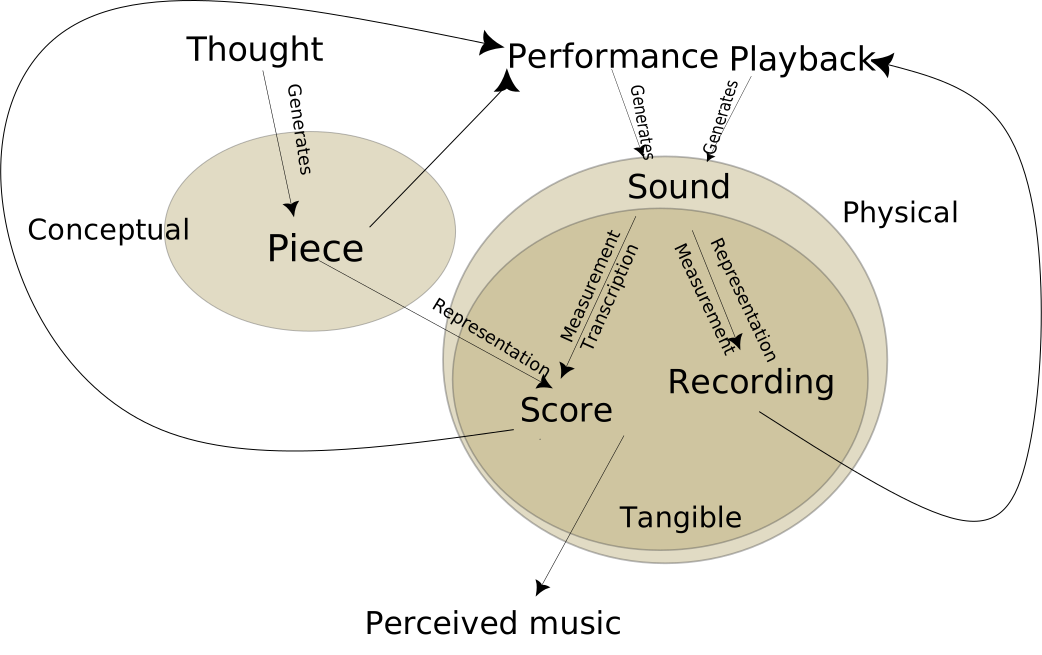
To summarize this chapter, I suggest the following framework for thinking about music research.
- There are two fundamental musical objects:
- sound of music (as generated by performances or playback).
- musical pieces (which may be more or less abstract than canonical “western” pieces).
- Two secondary musical objects:
- scores.
- recordings.
- Three musicking processes, which generate musical objects:
- Performance
- Playback
- Composition
These four types of objects can relate to each other in various ways, and different musical cultures tend to emphasize different objects/representations, and relationships between them.
As researchers, we might take any of these musical artifacts as “objects” to study. We might then consider different representations to be examples of measurements of the “true” object. For example, a transcribed score may be a “measurement” of a performance.