30 Measuring Humans
(Modified on 2026-08-11)
4,291 words
Music is a human activity. In music research, most of the research constructs we model and measure relate to human variables. This includes human behaviors, abilities, thoughts, attitudes, and knowledge. We also frequently study human artifacts—things created by humans—, like playlists, instruments, comments, scores, and audio recordings. However, we will generally approach the measurement of musical score/audio artifacts as a separate question (later in the course).
We can divide measurement protocols for human variables into three main types:
- physiological measures
- behavioral measures
- introspective measures
Physiological protocols measure humans’ physical or neural state; behavioral protocols measure human actions; introspective protocols ask people to report what they think or feel. Note that these three measurement approaches do not correspond to three types of human variables; In fact, all three approaches might be used as operational measurements for the same things. For example, we might want to measure the variable of how sleepy someone is: we could attempt to measure this variable either physiologically (e.g., heart rate), behaviorally (e.g., look for yawning), or through introspection (ask them to tell us how sleepy they are). Different approaches to human measurement have different strengths and weaknesses. As always, we should consider the reliability, validity, and feasibility of our measures.
Compared to constructs scientists measure in other fields—continental drift, chemical bonds, galactic orbits, radioactive decay, etc.—humans are…complicated. In fact, humans are the most complicated things we know of in the universe! This means that our operational measures of humans are inevitably reductive and simplistic. This is why human research is often seen as “soft” compared to other sciences. But the reason “hard” sciences can be precise is because they measure simple phenomena. The challenge of “soft” science is measuring very complex things using simplistic measures, while still maintaining plausible construct validity.
Physiological Measures
Physiological measurement protocols used in human research include topical (skin) measures, metabolic measures, and neurological measures. We might also measure more basic, static physiology like height, weight, or body shape.
For variable physiological measures, there is rarely a “correct” normal value. Rather, the measures must be normalized for each participant—for example, everybody has a different relaxed heart rate. To use such measures, you must generally first measure a participant for 1–20 minutes to get a reading of their baseline physiological state, and then see how their state changes relative to this baseline—for example, in response to your experimental manipulation.
Topical Measures
The word topical means “pertaining to the surface”. Hence, topical measures relate in some way to the skin; e.g., a “topical medicine” is a medicine that is applied to the skin. There are four classic topical measures: skin temperature, skin conductance, pilomotor activity, and electromyographic responses.
Note that nearly all topical measures are affected by ambient air temperature, which is thus an important covariate (and possibly a confound). Make sure to conduct topical measurements in environments with controlled, consistent temperatures.
Skin temperature changes slowly and can be measured with a topical thermometer. Some parts of the body tend to be warmer than others, and the distribution of heat can change over time. Skin temperature can also be imaged using an infrared camera. Skin temperature is determined principally by the amount of blood flowing near the surface of the skin. Some changes of blood flow can be seen directly—such as when a person blushes or when they go pale. But most changes are more subtle—although they can still be measured. When a performer is suffering from stage-fright, their hands and feet will tend to become cold. This occurs because of the constriction of blood vessels in the body’s extremities. This phenomenon is referred to as peripheral vaso-constriction.
A second important topical measure relates to how much we sweat. Our skin is covered with sweat glands and the amount we sweat can change rapidly; In particular, sweating tends to increase when our sympathetic nervous system is active. This can be associated with experiences of fear, the startle response, the defense reflex, the orienting response, feelings of anger, and even sexual arousal. This makes sweat a useful operational measure of our physical (and mental) state.
Sweat is a fluid with a high salt content, which means that it’s a relatively good conductor of electricity. Thus, to measure sweat, two electrodes are placed on the skin and a small (unnoticeable) voltage is applied continuously. When sweating increases, the resistance of the skin drops and so the electrical current increases, and this can be measured. These changes can be quite rapid—on the order of half a second or so—and are easily (and cheaply) recorded. This technique for measuring skin conductance is called by various names, which are all synonymous:
- Galvanic skin response (GSR)
- Electro-dermal activity (EDR)
- Skin-conductance response (SCR)
- They all mean the same thing!
A third topical response involves our body hair. Hair follicles can flex or relax; When the follicles flex the skin takes on a distinctive “goose-bump” texture. The technical name for this is the pilomotor (“hair moving”) response, or piloerection (“hair standing”). This response is closely related to, but distinct from, the phenomenon of frisson, where a listener experiences “chills” or “thrills.” Piloerection and frisson are associated with strong emotions, in particular fear and surprise—unfortunately, they are also associated with cold temperatures, which is a potential confounding variable! With the help of a video camera and a close-up lens, the pilomotor response can be observed visually. We simply point the camera at the back of the neck or the arm of a participant. Looking at the camera output, an observer can then visually characterize the degree to which the skin takes on a goose-bumped appearance.

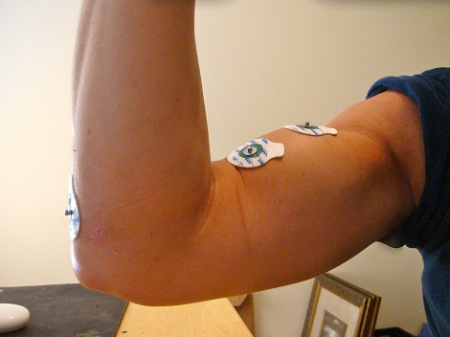
A fourth topical measure arises from the muscles underneath the skin, which produce electrical potentials that can be measured. These measures are referred to as electromyography (EMG). EMG potentials can be measured either at the surface of the skin, or more directly by inserting a small needle or electrode into the muscle. Muscles generate large electrical potentials when they’re flexed, but they also produce spontaneous electrical activity when at rest. The resulting muscle activity can be highly informative depending on the muscle being monitored. For example, facial muscles echo various emotional states. By way of example, EMG activity in the zygomatic muscles (involved in smiling) provides a good indication of positive feelings—even if there’s no visible evidence of smiling. An example of the use of EMG in music research is in the work of Ulf Dimberg (Dimberg 1987; Dimbergs 1989) who has demonstrated that EMG activity provides a useful measure of the perceived pleasantness or unpleasantness of a sound.
Metabolic Measures
Metabolic protocols measure body conditions under the skin’s surface. Classic examples of metabolic activity include heart-rate, blood pressure, (core) body temperature, and respiration.
Pulse can be measured with small devices that attach to the wrist or fingers, which can be quickly attached in the lab, or worn for long periods to collect data continuously. Two classic heart responses are of particular interest: the tachycardic and bradycardic responses.
- A tachycardic response occurs when the heart-rate increases briefly and then returns to normal. This is associated with fear or alarm.
- A bradycardic response occurs when the heart-rate decreases briefly, rebounds above normal briefly, and then returns to normal. This is associated with interest or attentiveness.
Another measure of interest is the heart-rate variability (or HRV). This has been found to be especially informative in a variety of different ways.
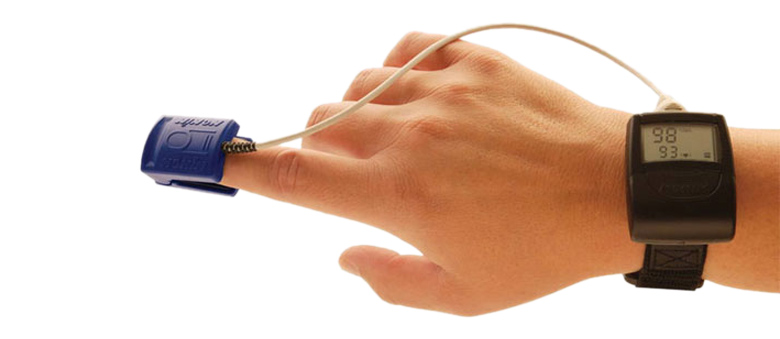
Another metabolic behavior is breathing or respiration. Respiration can be measured using a string-like or band-like device that’s placed snugly around a participant’s chest. It can also be measured using an electronic device taped to a person’s chest. Breathing influences the amount of oxygen in the body. Rather than measuring respiration, we measure blood-oxygen level using an oximeter that clips onto the finger.
A final important class of metabolic measures analyze hormone levels. Hormones are chemical messengers, commonly transported by the blood that influence cell behavior in many ways. Examples of hormones include epinephrine and norepinephrine (also known as adrenaline and noradrenaine), dopamine, serotonin, oxytocin, prolactin, cortisol, histamine, estrogen, testosterone, insulin, as well as others. Some of these hormones (like testosterone) can be measured in saliva. So we can have a participant simply spit into a small cup, or use a mouth swab. Another common technique has the participant chew on a small absorptive plastic device.
Other hormones can be measured only by taking a blood sample. Depending on the sensitivity of the assay method, the researcher may need only a small dab of blood (that can be collected from a pin-prick), or a larger sample of blood that would require a professional nurse to do a blood-draw.
Some hormones are present only in the brain. Unfortunately, these hormones can be measured only by examining the cerebro-spinal fluid—which is gathered through a spinal tap. This procedure is much too invasive to be used for casual research purposes, like studying music. An example of observing changing hormone levels in response to music is the work of Hajime Fukui (Fukui 2001) who found that testosterone levels are lower when people listen to their preferred music.
Neural Measures
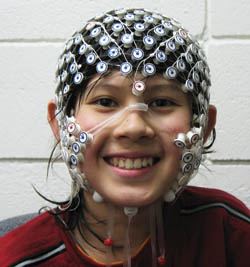
One of the most useful physiological measures is the electrical activity generated by the brain. Electroencephalography (EEG) measures tiny changes of voltage that reflect the electrical activity of large groups of neurons. Although these voltages are very small, they can still be measured by placing electrodes on a person’s scalp. Usually, a large number of electrodes are spread across positions on the scalp, and the voltage between different pairs is measured.
EEG measures are rather crude—representing the average activity of assemblies of millions of neurons. However, when enough neurons fire at roughly the same time, they create a big-enough electrical potential to be measured at the surface of the head. The most common use of EEG is to measure regular oscillations in neural activity—i.e., brain waves—at various frequencies; these rapid oscillations can be associated with different mental states.
In music-related research, it’s most common to look at the electrical activity that’s evoked in response to a particular sound. These are so-called event-related potentials (ERPs). ERPs have characteristic signatures that can indicate, for example, whether a person noticed or paid attention to a given sound. These signatures have proved particularly useful in answering questions about what infants are able to hear or distinguish. For example, research by Laurel Trainor and her colleagues has determined when infants are able to recognize atonal violations of tonal melodies. Infants can’t talk about what they hear, but their EEG responses can give important clues about how they’re experiencing the sounds.
The most well-known ERP in music research is called the mismatch-negativity (MMN) response. The MMN is a transitory change to your brain activity which occurs when a repeating pattern changes, creating an unexpected “mismatch.” For example, if you listen to a sequence of notes like “C C C C C C C C C D C C C C” played at a regular tempo, the “D” will elicit a MMN response in your brain. This measurement has been shown to be very reliable and even works when you are not consciously paying attention to the stimuli! The MMN has been used as an operational definition for “unexpected event” or “surprise.”
In psychological measurement protocols, unexpected stimuli are examples of “oddball stimuli”—any stimuli that (hypothetically) stands out from others. Studies that use the MMN are classic examples of an oddball paradigm, where the experimental manipulation involves “oddballs.”
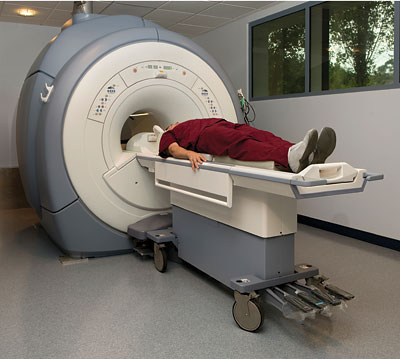
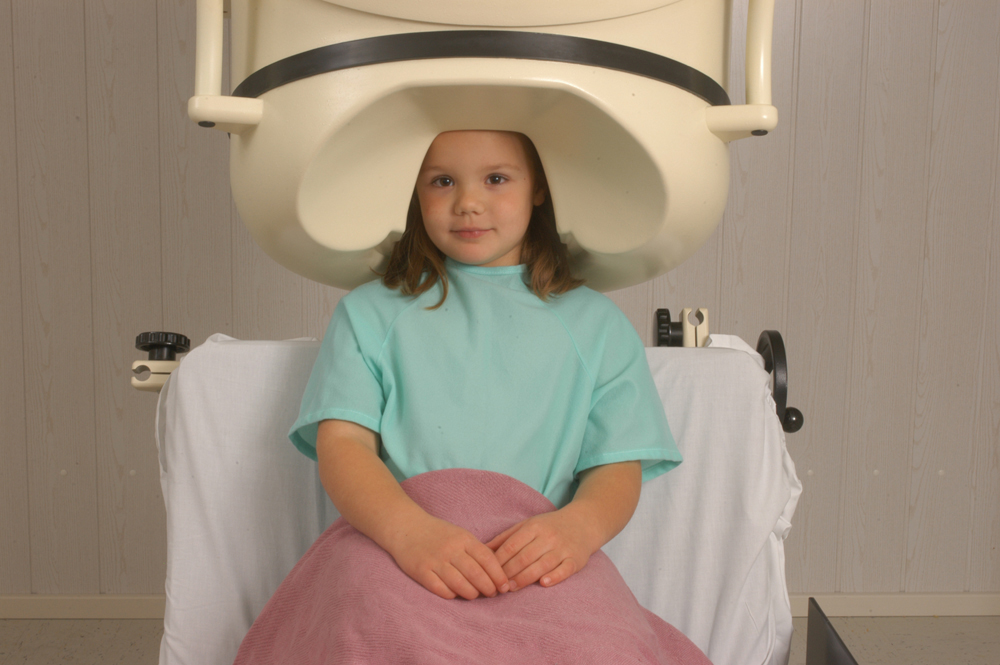
In the past decade, it’s become increasingly common to use brain scanners in music research. At least four types of scanners can be distinguished:
- Magnetic resonance imaging (MRI) can be used to measure how much oxygen is being used in different parts of the brain. Areas of the brain that are the most active use more oxygen, and MRI methods can be used to pin-point these places when a person is engaged in different tasks.
- Functional magnetic resonance imaging (fMRI) is a specialized form of MRI, which measures how blood flows between different parts of the brain.
- Positron emission tomography (PET) involves the injection of mildly radio-active substances into the blood-stream. Depending on the substance that is injected, PET can provide very useful indications of where in the brain a particular neurochemical is released or congregates. Using this technique, for example, Valery Salimpoor (2011) and her colleagues were able to show that listening to chill-inducing music released dopamine in regions of the brain associated with the experience of pleasure.
- Magnetoencephalography (MEG), like EEG, traces the electrical activity of the brain. However, it monitors magnetic information rather than voltage—giving much better resolution and is able to provide better information about activity going-on deeper in the brain.
These “brain scan” protocols give very detailed spatial information about activity within the brain (in three dimensions). They can represent points within the brain with millions of “voxels”—the three-dimensional equivalent of a pixel. However, they are slow, so they provide poor timing information. Typically, they show activity within 5–20 second windows, at best. In contrast, EEG gives very precise timing information, but very poor spatial positioning.
(Dis)Advantages of Physiological measures
The biggest issue with physiological measures is that they are expensive and invasive. Though a few of the simplest topical and metabolic measures (skin temperature, heart-rate, etc.) are not that difficult to measure, they are still more invasive and time consuming than behavioral and introspective measures. Other physiological measures vary from expensive and uncomfortable (GSR, EEG) to extremely expensive and difficult (MRI, blood cultures), etc. This makes getting funding and formal ethics approval much more complicated.
The difficulty with physiological measures is not “just” conducting the measurements, but also analyzing the data. The signal processing techniques used for EEG and MRI (etc.) are, in themselves, a huge field of study. Significant expertise with these specific tools is needed to make (or publish) any reasonable conclusions.
The greatest danger of physiological measures—especially neurological measures—is that they seem super fancy and cool, which can make it easy for us, our readers, and the general public to turn off our critical thinking skills. Physiological measures have an alluring “hardness” to them; They seem much more objective and precise than other human measurements. After all, measuring activity inside the brain must get us closer to the “real” mental constructs we are interested in, right? Emotion, preferences, and perception…these are processes that happen in the brain—the construct validity is a no brainer (pun intended)!
Many people have the impression that neurological measures can “see” human variables like “concentration” or “sadness”—this impression is false. The neural measurement techniques we have (so far) can only measure extremely gross changes in neural activity, involving millions or billions of neurons. The actual workings of cognitive phenomena, like emotion, certainly involve millions of neurons interacting in complex patterns, none of which are “visible” to something like EEG or MRI. What’s more, the physiological signals we measure are extremely noisy—i.e., they have lots of random error. Many layers of processing, analysis, and argument are needed to connect readings from EEG/MRI to actual constructs that interest us. Physiological measures are, like any other measure, imperfect tools; They can be useful, but they should be regarded with skepticism, and their construct validity should not be taken for granted.
You’ve probably noticed that I am a little bit down on physiological measures! They certainly have advantages. A key advantage of these approaches is that they are difficult (but not impossible) for participants to control or influence. They also bypass (to some extent) any reliance on human language and interpretation. This means that many significant sources of bias in human research are limited (but not removed).
Physiological measures also have the advantage of being passive—for example, you can measure people’s heart-rate or GSR while they sit passively listening to music. In fact, the LIVELab at McMaster University in Ontario, is a performance venue with metabolic measurement devices built into the first row of seats!
Physiological measures are, potentially, very valuable in music research. However, to see their real value, we have to get past our naive excitement about the measures. The MMN (mismatch-negativity) response is an excellent example. This response can be measured reliably and appears to be a valid measure of the construct “surprise.” Interpretation of the measurement is quite limited: it is associated with a very specific type of surprising scenario. However, having this reliable measure can be very useful for investigating other phenomena. For example, let’s say you want to know whether a non-musician can tell the difference in timbre between an oboe and an English horn. You could play a sequence of oboe notes interspersed with an “oddball” English horn playing the same note. If no MMN is observed, this suggests the person can’t differentiate the two timbres. The MMN response has been used as a tool like this in many productive research studies.
MRI and MEG are the sexiest tools of neuroscience—perhaps of all science. Don’t be fooled that they can “show us” what is happening in the brain. Instead, think of them as tools, used like an EEG to identify responses like MMN—only spatial responses, not timing responses.
An MRI shows us which brain regions are active at a given time; the problem is that all brain regions are active all the time! MRI analyses average huge amounts of noisy variation across the brain regions to come up with statistical estimates of which regions (voxels) are more or less active relative to other regions. What researchers using MRI have typically done is look for reliable changes in activity which correlate with feelings/thoughts/behaviors their participants experience. For example, we might find that conscious concentration is associated with a 4% increase in activity in the ventromedial nucleus and an 8% decrease in the gracile nucleus. If this measurement is shown to be reliable, we can use it to investigate other questions. However, these sorts of measurements are extremely noisy, complicated, big-picture views of what is happening in the brain.
Behavioral Measures
Behavioral protocols measure what people do. These protocols may involve naturalistic, passive observation of human behaviors in the field. However, behavioral protocols are often experimental, where we ask or incite people to do something and see what happens—usually in a controlled lab environment.
In some cases, the behaviors we observe are meant to be direct measures of the construct we are interested in. For example, if we are studying how ensemble members play together, there are many aspects of the behavior “playing together” which we could measure. However, behaviors can also be used as indirect measures of other constructs: For example, we might observe how often somebody smiles or frowns as an operational indicator of their emotional state. Or, we might look to see if somebody bobs their head in time as a measure of the “grooviness” of music.
Gross Behaviors
Gross behaviors are those behaviors that involve externally observable actions. Examples of gross behaviors include bobbing your head, swaying, blinking, humming, singing, talking, shouting, and laughing. Two of the most common gross musical behaviors are clapping hands and tapping feet. Gross behaviors can also involve aspects of posture, such as slumping, or leaning, lowering your head, or sitting upright. Gross behaviors also include facial expressions, such as frowning, raising or lowering your eyebrows, sneering, pouting, and so on. In the case of performers, there are many other forms of gross behaviors to observe: When playing a musical instrument, performers move their arms, wiggle their fingers, blow air through their mouths, and so on.
In general, gross behaviors can be captured through photographs, through video and audio recording, or simply by live, on-site observation. For example, you might ask a drummer to play a “swing” groove on a cymbal and observe (measure) what swing-ratio they play. However, special instrumentation may be used as well, notably motion capture devices.
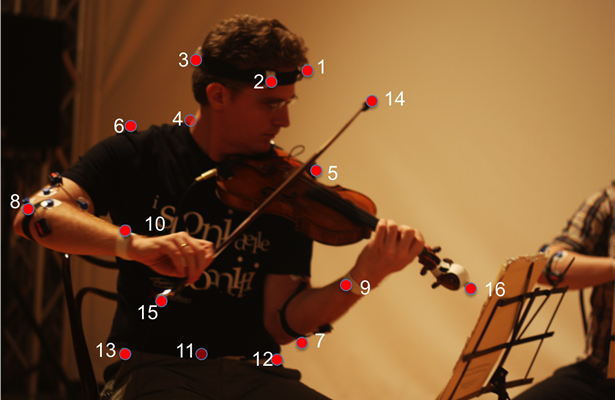
A particularly illuminating set of gross behaviors are those related to the eyes. We can identify four main aspects to eye behavior:
Blinking: one of the most reliable indicators of the startle response. When you hear a loud unexpected sound, it’s very likely that you’ll blink.
Pupil size: The dark region at the center of the eye responds very quickly and continuously to changes of stimulation, including sounds.
Eye movements: known as saccadic movements. The human eyes engage in many “micro-saccades”—quick eye movements—unconsciously. The speed and frequency of saccades can be correlated with emotional state; For example, people make more frequent saccadic movements when they are nervous.
Gaze: what we look at, and when, can reveal a lot about our cognitive processes—what we are thinking about, what we are focusing on, etc.
John Sloboda (1985) has carried out studies examining how the eyes move when musicians read musical notation. It turns out that the movements of the eyes differ depending on whether the music is predominantly homophonic or predominantly polyphonic. There are also observable differences between how the eyes move for highly trained musicians versus less experienced musicians reading musical scores.
More recently, Dr. Arthur (2023) and Noel Alben worked to replicate an old study on the relationship between pupil dilation and concentration. The field of pupilometry has grown a lot in the last decade, and technology for measuring pupil size, saccadic movements, and gaze is pretty sophisticated, while not being too invasive.
Static Behaviors
Not all “behaviors” are dynamic things that are happening right now. We might, for example, observe a person’s hair-style or tattoos, the sort jewelry or clothing they are wearing, or what kind of car they drive to a concert—perhaps we hypothesize that country music fans are more likely to drive pick-up trucks. We can think of these as static behaviors.
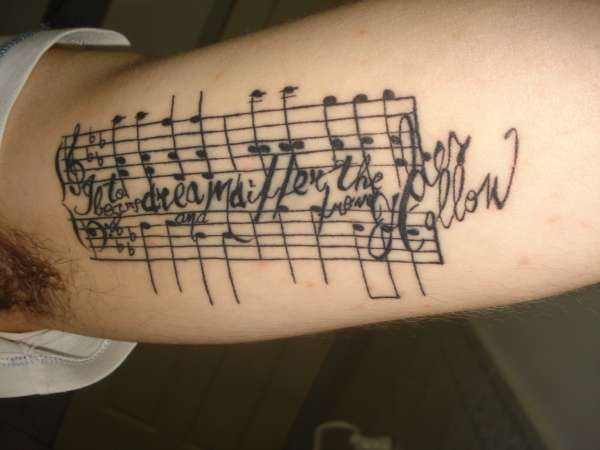
Another case are artifactual behaviors. People create things: in cultures all over the world we find all kinds of different musical instruments; musicians also make recordings—in lots of different formats; people make music videos, they take photographs, they write in diaries and blogs, they write program notes, they even write lyrics down on slips of paper. Of course, the most important musical “artifacts” are sound recordings and scores, but we will study those in more depth later.
Introspection
In many human research projects, we are ultimately interested in what people are thinking or feeling. Though we can find various behaviors and physiological responses that correlate with our thoughts and feelings, the thoughts and feelings themselves cannot be measured externally. Another, more direct, approach to measuring these mental phenomenon is through introspection and self report. We ask someone to think about what they feel, think, or believe, and tell us (in some way).
There are a number of problems with introspection and self report. Frankly, people don’t always understand their own inner workings, thoughts, or motivations. A person might think that they like Classical music because of the sophisticated counterpoint, but maybe the real reason is that they associate the timbres with pleasant childhood activities. Even if a person’s introspections are accurate, they may be unable to accurately describe or articulate their feelings. What’s more, the act of introspection (thinking) may change our “natural” feelings and thoughts. Introspection can be inconsistent, so reliability can be a problem.
Despite these drawbacks, self report provides us by far the most detailed and nuanced measurements of complex human phenomenon. A human can think for a moment and say things like “the best part is the bass part in measure 8, where the syncopated kick drum notes accentuate the offbeats in a surprising way.” We might measure a mismatch-negativity (MMN) response in an EEG as an operational definition of “unexpected event.” However, a human can tell you things like “that surprising out-of-key note makes me feel exhilarated.” No other measurement approach can even come close to measuring this level of detail about musical experience.
Ultimately, nearly all empiricism relies on a person saying “I know what that is” and naming it. For example, most Machine Learning research relies on datasets labeled by human experts. Self report measures are the dominant form of measurement in psychology, user design studies, sociology, and many other fields. This is why we have an entire other chapter dedicated just to self-report methodology. Note that “self report” is typically considered part of the field of “behavioral psychology”—filling out a survey is itself a behavior, so it is a measure of behavior. However, it can be useful to distinguish self report from other behavioral measures.
Operational Definitions
For any given human behavior, there are many ways we might actually measure it. Our operational definition for the variable we are measuring is defined, as always, by our specific measurement protocol. For example, let’s say we want to measure how often musicians make “eye contact”—a gross behavior. For example, we might
- Video duos of musicians performing
- Ask an independent rater to watch the videos and note the time stamps every time they see the musicians make eye contact with each other.
- Count the number of eye-contact events per minute.
The resulting variable is a count (natural number) variable. There are many other ways we could measure this same behavior, resulting in different sorts of variables.
- We could proceed with steps 1)–2) from above, but then code eye-contact as a proportion of the total performance time.
- We could interview musicians and ask them to estimate how often they make eye contact.
- We could have musicians wear pupilometry eye-goggles while performing, and design an algorithm to identify eye-contact in the data.
- Etc.
Social Behaviors
When behaviors involve groups of people, the social element is foremost. Many social behaviors are really types of gross behaviors, but when the behaviors relate to how people interact it’s more common to speak of social behaviors.
Social behaviors include body language such as making eye contact, nodding in agreement, orienting toward or away from someone, and smiling or frowning. Since facial expressions are normally intended to be communicative, one might want to regard all facial expressions as social behaviors rather than gross behaviors.
The actions of crowds at a concert may include dancing, group clapping, swaying, arm-waving, kneeling, shouting, singing or chanting in unison, and so on. Group movements may be synchronous or asynchronous. Interpersonal gross behaviors may include conversing, holding hands, winking, and other interpersonal actions.
Social behaviors also include networking information. On Facebook, for example, social networks are evident in the patterns of “likes.” Social networks are also evident in e-mail contact lists, in stored phone numbers, subscription lists, and so on.
In recent years, important research on the social aspects of music have been carried out using large amounts of data collected through popular web services such as Youtube, Hulu, i-Store, and Amazon. We know, for example, that how people evaluate music is strongly influenced by how other people evaluate music within a perceived social group. For example, Matthew Salganik (2006) and his colleagues split 14 thousand people on the web into eight randomly assigned social groups. They showed that the popularity of new (never heard-before) pop songs depended primarily on the mutual awareness of what other people in the social group were listening to. All eight social groups started off with the identical roster of new songs, but they diverged in their musical preferences simply through the happenstance of social influence.